15 Most Interesting Facts About the World Wide Web

The World Wide Web or simply Web has been with us for almost thirty years. With all these years, there must be a great history of it. Lots of historical activities have taken place within it and quite a number of them are worth remembering. Also, there are some mind-boggling titbits about the World Wide Web. Here are the 15 interesting facts about world wide web that you should know.

Interesting facts about the World Wide Web

1. The first proposal for the World Wide Web was written in 1989

A British engineer and a scientist by the name Sir Tim Berners-Lee wrote the first proposal of what would become the World Wide Web in 1989. Currently, the engineer is the director of the World Wide Web Consortium(W3C).

2. Mosaic web browser was launched in 1993
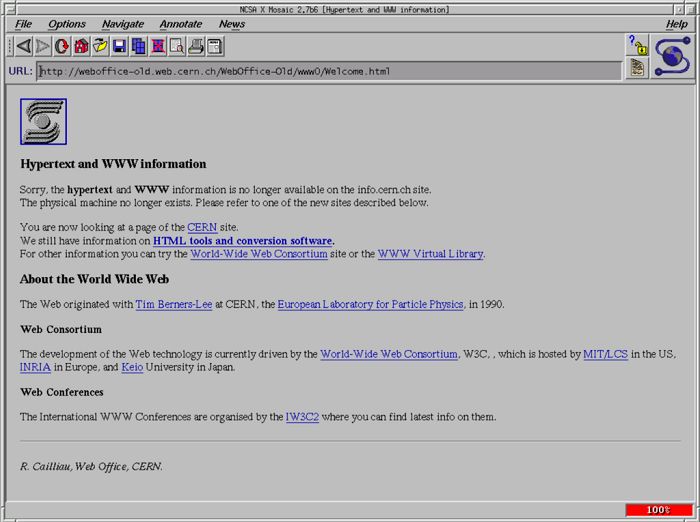
Mosaic_Web_ Browser-compressed

1993 is believed to be a very important year in the history of the World Wide Web. It was the year which the Mosaic web browser was launched. This was a graphical web browser that was developed by a team of experts at the National Center for Supercomputing Applications at the University of Illinois. Mosaic is one browser that is heavily credited for the huge popularity of the world wide web.

3. The first website went live on August 6 1991

Berners-Lee and a team of other engineers who worked at CERN launched the first ever website in 1991. the domain name of the site is http://info.cern.ch  and its landing page had only 153 words. This was historic as it marked a new beginning of the World Wide Web where hypermedia information can be easily accessed.

Also, Read: 10 Interesting Websites on the Internet

4. The Freedom Ring

In 1993, CERN announced that the World Wide Web technology will be available to everyone free of charge. The declaration meant that the main components of this technology will remain in the public domain. This means that anyone regardless of the location will be free to use these components.

5. Archie was the first search engine

Archie was the first-ever search engine. It went live in 1990. From there, other search engines such as Google, and Yahoo were developed.

6. Web Surfing

The term “ Surf the internet” was invented by a New York librarian who was going by the moniker Net-mom. Later on, surfing the internet became an acceptable term ins the World Wide Web.

7. The internet is not Web and the Web is not internet

Most people assume that the two mean one thing. Even those in the tech world seem to have the same thought. The truth of the matter is the two are completely different things. The internet was already there long before the World Wide Web came into existence.

8. Billions of people surf the web daily

It is estimated that at least more than 3 billion of the worlds population surf the web daily. The high number of people who surf have been boosted by the improved accessibility of the internet worldwide.

9. China rocks the web most followed by India

According to the most recent statistics, China leads as a country with the most active web surfers. It is then followed by India then America.

10. There are more than 1.8 billion websites

This is according to the 2018 survey that was released by Netcraft Web Server Survey. However, only a small fraction of those websites receive visitors.

11. The World Wide Web Consortium (W3C) is the main international standards organization for the World Wide Web. This consortium was founded by Tim Berners-Lee.

12. Pornography forms the biggest chunk of the World Wide Web. This is despite the fact that the first website that used .xxx domain went live in 2011.

13. The first photo was posted on the web in the year 1992.

14. NeXT computer that was used by Tim Berners-Lee automatically became the first web server. It was also the first computer to write the web browser

15. The number of devices connected to the web exceeds that of the human population.
Difference between a programming and scripting language’s

Often people use the terms scripting language and programming language synonymously, but these two terms have more difference than you know of. Although all scripting languages are programming languages, all programming languages are not scripting languages.

Earlier, programming languages were written to build products such as PowerPoint, Internet Explorer, Microsoft Excel, and Microsoft Word, to name a few. However, as time passed, there arose a need to upgrade the programming languages to incorporate additional functionalities and provide an enhanced programming interface. Thus, scripting languages came into being. The primary difference between a scripting language and a programming language is in their execution – programming languages use a compiler to convert the high-level programming languages into machine language, on the other hand, scripting languages use an interpreter. While a compiler compiles a code in a complete chunk, an interpreter compiles a code line by line.

Let us now look at some of the major differences between a programming language and a scripting language.

Definition

A programming language is essentially a formal language that combines a set of instructions that can be fed into the computer to generate a specific output. A scripting language is a programming language that supports scripts which are programs written exclusively for a special runtime environment to automate the execution of a specific action/function.

Interpretation

Programming languages are compiled into a more compact design that does not require to be interpreted by another language or application. Scripting languages are written in one language and interpreted within another program, for instance, JavaScript has to be incorporated within HTML which will then be interpreted by the Internet browser. Thus, programming languages run independently of a parent program, but scripting languages run inside another program.

Design

Programming languages are designed to facilitate a full-fledged code and software development whereas scripting languages are specifically designed to make coding faster and much simpler.

Development

Coding with programming languages is relatively difficult as many lines of code are required for a single function. Creating a code function with a scripting language is easier as it requires only a few short and specific lines to be written. Thus, writing a  full-fledged code with programming languages usually take a longer time to develop as more lines need to be written while coding with a scripting language requires less time as smaller chunks need to be written.

Categories

Programming languages are divided into five subcategories: First generation, Second generation, Third generation, Fourth generation, and Fifth generation. Scripting languages have only two subcategories: Server-side scripting languages and client-side scripting languages.

Conversion and hosting

Since programming languages use a compiler, it is a one-shot conversion. Scripting languages, on the other hand, demand line by line conversion. Programming languages are self-executable; they do not require a host. Scripting languages require a host.

Speed

Compiled programs run generally run faster than interpreted programs since compilers read and analyze the code at once and report errors (if any) collectively. An interpreter, however, reads and analyzes a code line by line and every time it detects an error, it stops to address them one by one.

Languages

C, C++, C#, Java, Basic, COBOL, and Pascal, are some examples of programming languages. JavaScript, Perl, PHP, Python, Ruby, Rexx, Ruby, GameMonkey, etc., are some of the most widely used scripting languages.

Conclusion

Overall, as we mentioned before, the execution process and environment are the primary differentiating factors between programming languages and scripting languages. Programming languages are used to develop applications and scripting languages are used to write code that can enhance and control application behavior.

What is Python and why is it so popular now?

Python has recently been doing quite the rounds. Well, no this ain’t a new language and was developed long back in the year 1991. However, Python has become quite popular these days. This is an interpreted programming language which is being used worldwide to develop websites, algorithms and simplifying the process of automation.

You might think why Python is important when there are so many other languages too.

Any program would be of a few lines only if coded using Python instead of another programming language. Python makes it really easy and simple to code lines correctly. The process of coding Python is so simple that it has helped take this functionality to an entirely new level. Now it has become much easier to achieve artificial intelligence projects which were more like a dream initially.

While there are other programming languages too, Python has made it easier for you or me to code and develop algorithms, programs or websites instantly. So, basically, Python has given us wings to fly. This allows a person to develop anything new and creative for the society or people.

Reasons why you should learn Python

Python is such a language that can help you develop almost anything. It is a great language for developing backend tools and other kinds of software and artificial intelligence stuff. Let us see why you should try learning Python.

1. User-friendly language

It is very easy to code using Python. The easy guide and simple language make it possible for anyone to build tools and prototypes. Now, the best thing here is that someone who may not have liked coding previously would definitely love using Python. This is the only reason that Python has gained so much popularity these days.

2. Easy to learn

Just like it is easy to code Python is easy to learn as well. It is exactly like the English language. A three-line java or c code can be replaced with a three words Python code. Python is absolutely free and open source platform. There is no need for any complex language to deal with Python.

3. Extensibility of Python

Python is a universal language. It doesn’t have strict guidelines or hardcore rules that need to be followed. They allow performing all kinds of operations easily. There is absolutely no need to choose a perfect platform as it is supported by most platforms starting from Windows to Linux. It is even possible to integrate Java and .net components easily including these.

4. Testing

Python makes it possible to check ideas and products for companies. The main advantage is that Python has an inbuilt testing framework that covers debugging and workflow. There are tools such as selenium and splinter that can make this testing work possible even in cross-browser and other frameworks. Testing is quite a tedious job and Python is the perfect language that helps achieve this.

5. Python’s Role in Big Data and Automation

Python supports Big Data operations. It has the ability to help process different kinds of information. It has now become possible to help support parallel computing using Python. The use of Python in big data makes it easy to process it. Python is of equal importance in automation as well simply because it can be used as a scripting language too.

These are some of the reasons that you should consider to Learn Python Programming from this online Python training course.

How To become a certified Python Programmer?

To become a certifies Python programmer you need to know the basics of the Python programming language. There are a number of online websites and applications which can help you develop Python programs. These websites, apps, or even institutions would teach the fundamentals and then provide a certification on completion of the course.

The course certification process, timing, course duration, course fee varies. However, if you can learn Python from a recognized institute, then you can definitely own a Python programmer certificate.

What is Document Object Modal?(DOM) in web development.

Basics Behind the DOM?

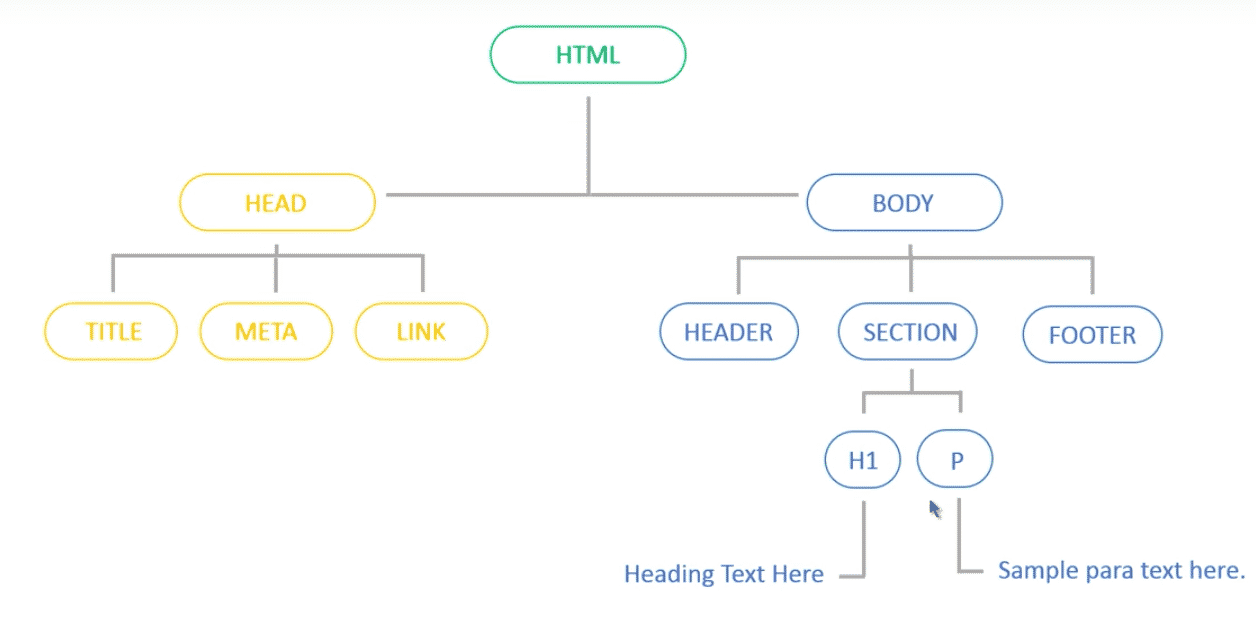
We all know that HTML is the language of the web with a specific syntax and rules generally documented in regular text. But, here we follow HTML syntax rule and regulations rather than general grammatical rules. The basic word in HTML is the “tags” i.e.“< >”.  The browser turns the HTML tags into elements that form a tree.

Now, How does the browser do this? What is the concept behind this? Yes, the answer is the DOM. Browsers know how to convert the HTML tags into a tree with the help of DOM (Document Object Model).

What is DOM?

D.O.M stands for Document Object Model as mentioned above but what do these terms mean.

D.O.M stands for Document Object Model as mentioned above but what do these terms mean.

Documents mean: - Your HTML page document.
Object means :- Elements and attributes in your page.
Model means: - Tree structure of HTML Elements.

By definition: “DOM is the standard convention for representing and interacting with elements in HTML. Each HTML tag creates an element in the DOM that the browser uses to display the page. We know that an element in HTML is created by a starting tag and ending tag for example,

< tag> content </tag>

The content between the tags can be empty, it can be text or it can be another element.

If I talk more about DOM then, whatever documents objects that have been created can be manipulated according to our preference. Doing so saves a lot of time and we can actually change the page without going and changing any of the HTML content. Now, here comes the role of the Javascript or it’s libraries like Jquery, the language that is used to talk to the DOM.

Technically, a DOM is also an API (Application Program Interface) or a type of API which are really powerful. Now, if you are already familiar with the language like Javascript or Jquery then it is pretty indicative that you have been working with the DOM for quite a while.

The goals of the HTML-specific DOM specification are:

  • to specialize and add functionality that relates specifically to HTML documents and elements.
  • to address issues of backward compatibility with the Level 0 Document Object Model.
  • to provide convenience mechanisms, where appropriate, for common and frequent operations on HTML documents.

The HTML DOM is a standard for how to get, change, add, or delete HTML elements or nodes. So, we can summarise what exactly it defines.

  • The HTML elements as objects
  • The properties of all HTML elements
  • The methods to access all HTML elements
  • The events for all HTML elements

Why We Should Learn HTML DOM?

DOM is W3 Standard to understand the structure of the HTML page so that we can dynamically create, read, update, delete and manage DOM elements using JavaScript or Jquery DOM methods. Moreover, HTML DOM helps us to understand and control the elements structures using the JavaScript methods.

If you understand the DOM structure of an HTML page, you can easily control its elements, attributes, and all nodes.

Implementation of DOM Using JavaScript

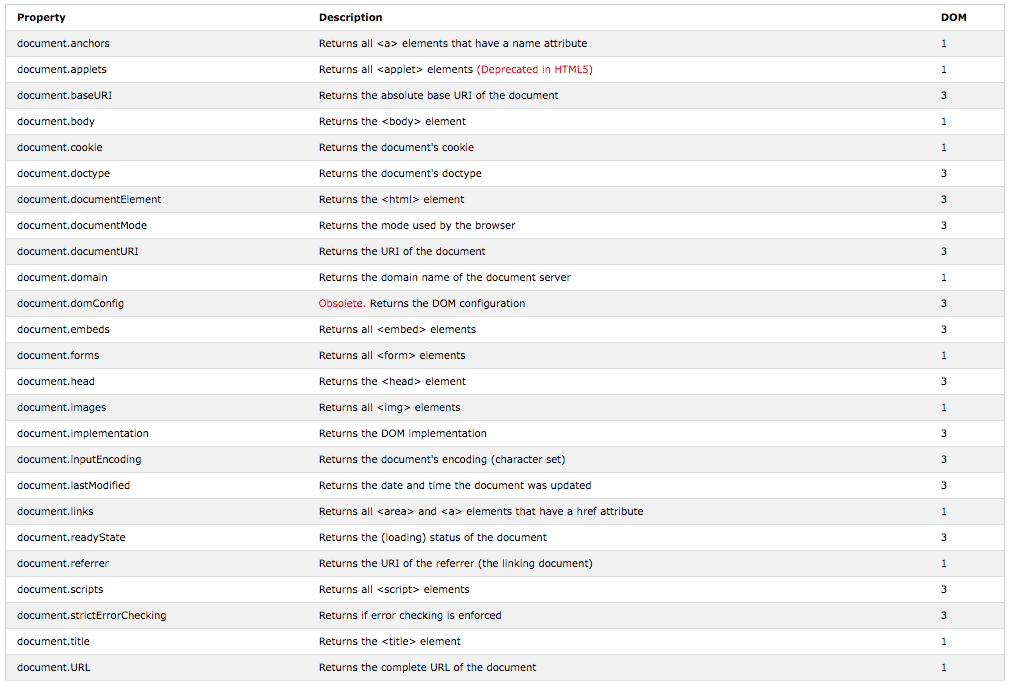
Here is the list of the HTML DOM Document Object.

1. Finding HTML Elements

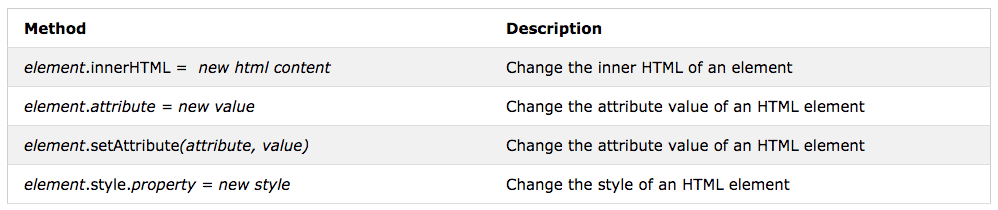
2. Changing HTML Elements

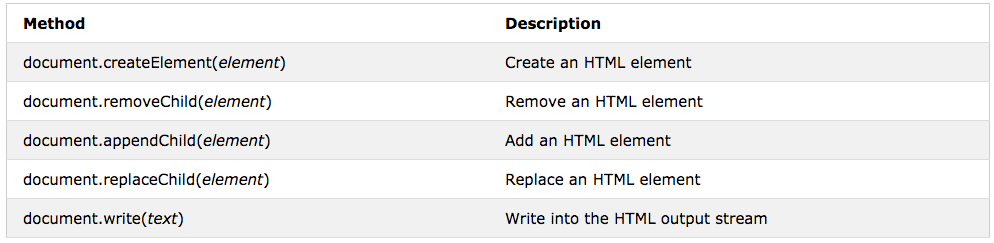
3. Adding and Deleting ELements

4. Adding Event Handlers

5. FInding HTML Objects

Apart from these, you can also use Javascript for creating animations, events, navigation, nodes, and collections. A Sample program of how to use DOM is written below.

<html>
<body>
<p id="demo"></p>

document.getElementById("demo").innerHTML = "Hello World!";

</body>
</html>
Design a site like this with WordPress.com
Get started